Simple Linear Regression

Prof. Eric Friedlander

Aug 28, 2024

Topics

  • Use simple linear regression to describe the relationship between a quantitative predictor and quantitative response variable.

  • Estimate the slope and intercept of the regression line using the least squares method.

  • Interpret the slope and intercept of the regression line.

Computation set up

# load packages
library(tidyverse)       # for data wrangling
library(ggformula)       # for plotting
library(fivethirtyeight) # for the fandango dataset
library(broom)           # for formatting model output
library(knitr)           # for formatting tables

# set default theme and larger font size for ggplot2
ggplot2::theme_set(ggplot2::theme_bw(base_size = 16))

# set default figure parameters for knitr
knitr::opts_chunk$set(
  fig.width = 8,
  fig.asp = 0.618,
  fig.retina = 3,
  dpi = 300,
  out.width = "80%"
)

Data

Movie scores

Fandango logo

IMDB logo

Rotten Tomatoes logo

Metacritic logo

Data prep

  • Rename Rotten Tomatoes columns as critics and audience
  • Rename the dataset as movie_scores
movie_scores <- fandango |>
  rename(critics = rottentomatoes, 
         audience = rottentomatoes_user)

Data overview

glimpse(movie_scores)
Rows: 146
Columns: 23
$ film                       <chr> "Avengers: Age of Ultron", "Cinderella", "A…
$ year                       <dbl> 2015, 2015, 2015, 2015, 2015, 2015, 2015, 2…
$ critics                    <int> 74, 85, 80, 18, 14, 63, 42, 86, 99, 89, 84,…
$ audience                   <int> 86, 80, 90, 84, 28, 62, 53, 64, 82, 87, 77,…
$ metacritic                 <int> 66, 67, 64, 22, 29, 50, 53, 81, 81, 80, 71,…
$ metacritic_user            <dbl> 7.1, 7.5, 8.1, 4.7, 3.4, 6.8, 7.6, 6.8, 8.8…
$ imdb                       <dbl> 7.8, 7.1, 7.8, 5.4, 5.1, 7.2, 6.9, 6.5, 7.4…
$ fandango_stars             <dbl> 5.0, 5.0, 5.0, 5.0, 3.5, 4.5, 4.0, 4.0, 4.5…
$ fandango_ratingvalue       <dbl> 4.5, 4.5, 4.5, 4.5, 3.0, 4.0, 3.5, 3.5, 4.0…
$ rt_norm                    <dbl> 3.70, 4.25, 4.00, 0.90, 0.70, 3.15, 2.10, 4…
$ rt_user_norm               <dbl> 4.30, 4.00, 4.50, 4.20, 1.40, 3.10, 2.65, 3…
$ metacritic_norm            <dbl> 3.30, 3.35, 3.20, 1.10, 1.45, 2.50, 2.65, 4…
$ metacritic_user_nom        <dbl> 3.55, 3.75, 4.05, 2.35, 1.70, 3.40, 3.80, 3…
$ imdb_norm                  <dbl> 3.90, 3.55, 3.90, 2.70, 2.55, 3.60, 3.45, 3…
$ rt_norm_round              <dbl> 3.5, 4.5, 4.0, 1.0, 0.5, 3.0, 2.0, 4.5, 5.0…
$ rt_user_norm_round         <dbl> 4.5, 4.0, 4.5, 4.0, 1.5, 3.0, 2.5, 3.0, 4.0…
$ metacritic_norm_round      <dbl> 3.5, 3.5, 3.0, 1.0, 1.5, 2.5, 2.5, 4.0, 4.0…
$ metacritic_user_norm_round <dbl> 3.5, 4.0, 4.0, 2.5, 1.5, 3.5, 4.0, 3.5, 4.5…
$ imdb_norm_round            <dbl> 4.0, 3.5, 4.0, 2.5, 2.5, 3.5, 3.5, 3.5, 3.5…
$ metacritic_user_vote_count <int> 1330, 249, 627, 31, 88, 34, 17, 124, 62, 54…
$ imdb_user_vote_count       <int> 271107, 65709, 103660, 3136, 19560, 39373, …
$ fandango_votes             <int> 14846, 12640, 12055, 1793, 1021, 397, 252, …
$ fandango_difference        <dbl> 0.5, 0.5, 0.5, 0.5, 0.5, 0.5, 0.5, 0.5, 0.5…

Movie scores data

The data set contains the “Tomatometer” score (critics) and audience score (audience) for 146 movies rated on rottentomatoes.com.
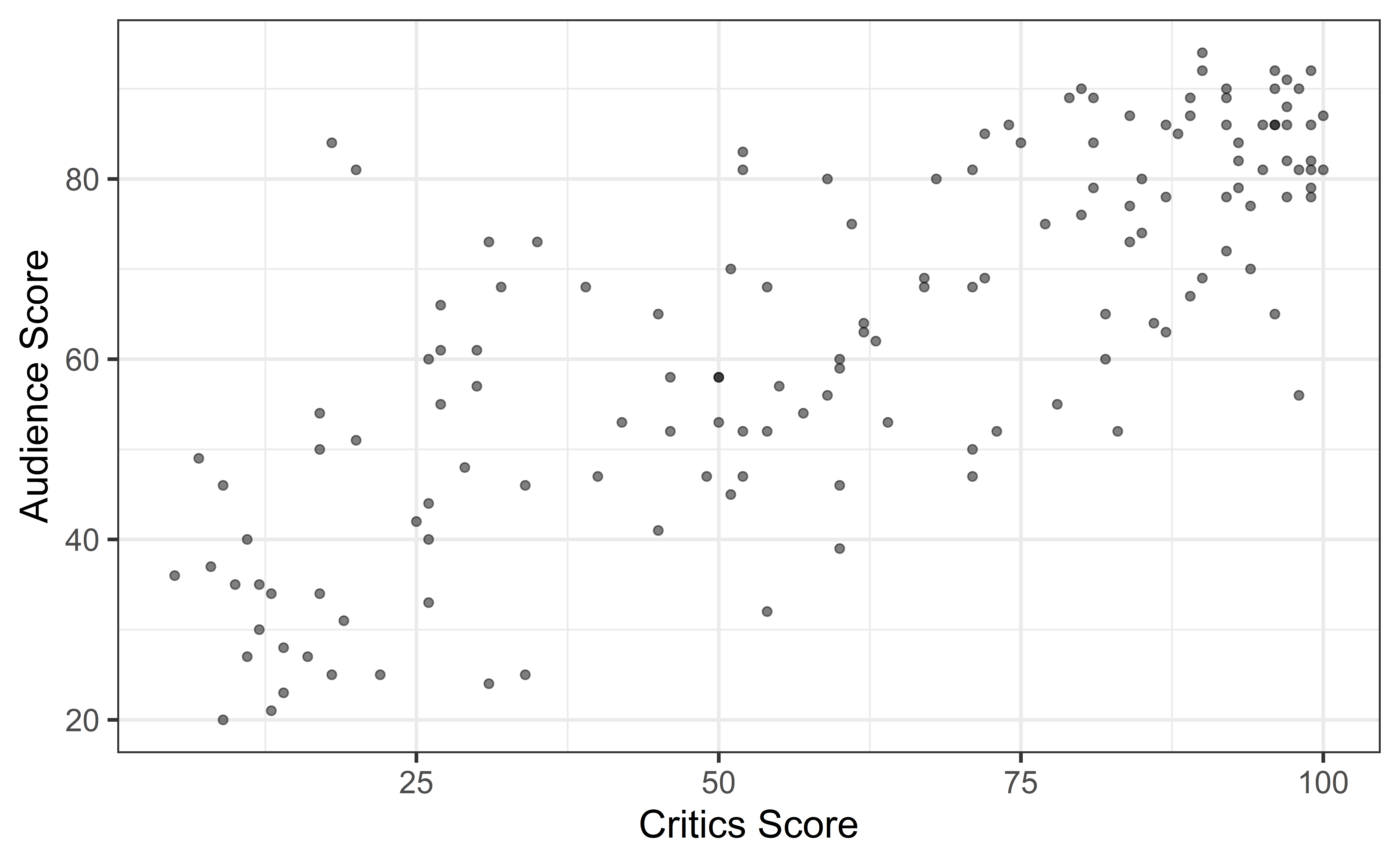
Code
movie_scores |> 
gf_point(audience ~ critics, alpha = 0.5) |>  
  gf_labs(x = "Critics Score" , 
       y = "Audience Score")

Movie ratings data

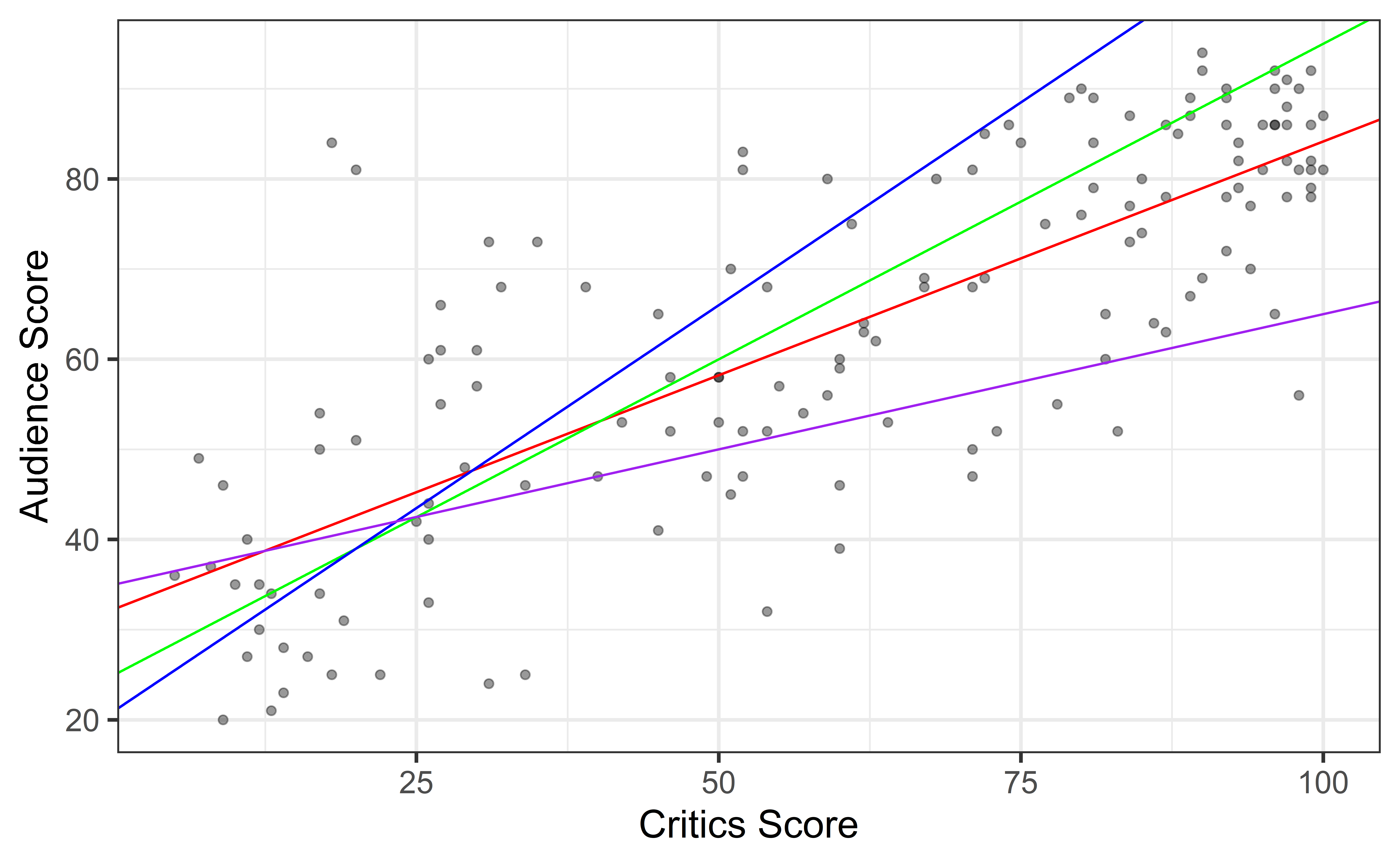
Goal: Fit a line to describe the relationship between the critics score and audience score.
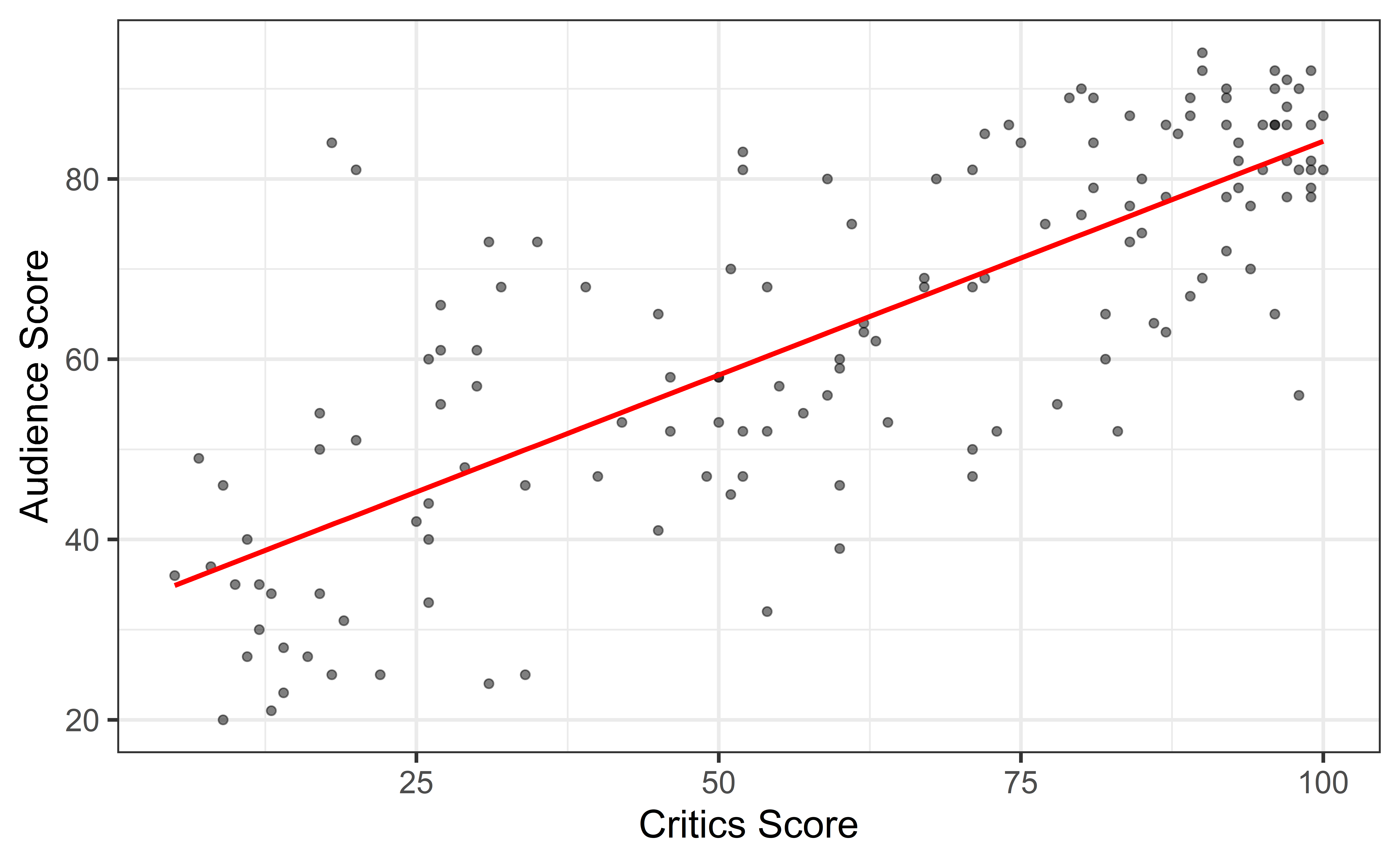
Why fit a line?

We fit a line to accomplish one or both of the following:

Prediction

What is the audience score expected to be for an upcoming movie that received 35% from the critics?

Inference

Is the critics score a useful predictor of the audience score? By how much is the audience score expected to change for each additional point in the critics score?

Terminology

  • Response, Y: variable describing the outcome of interest

  • Predictor, X: variable we use to help understand the variability in the response
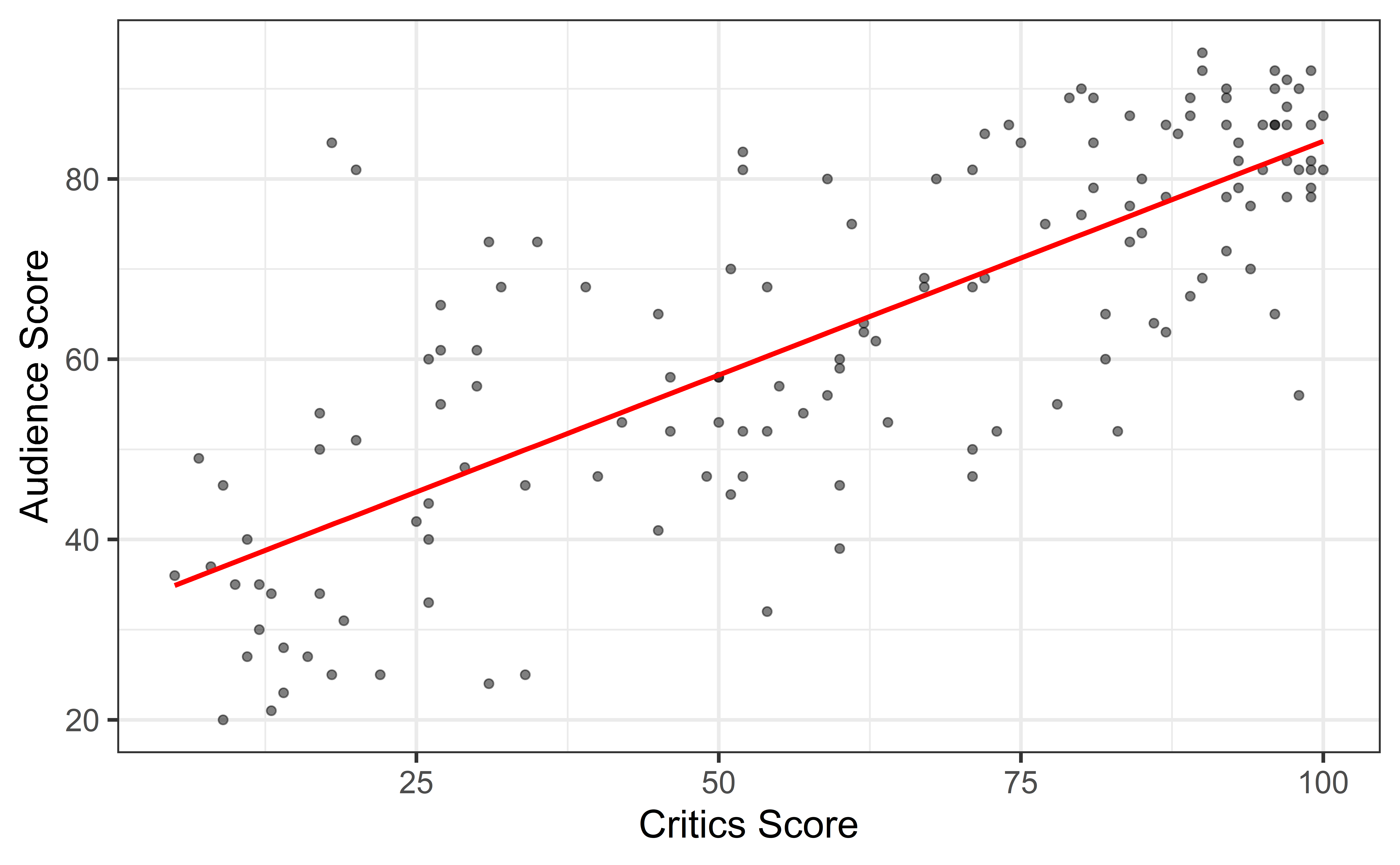
Regression model

Regression model: a function that describes the relationship between a quantitive response, \(Y\), and the predictor, \(X\) (or many predictors).

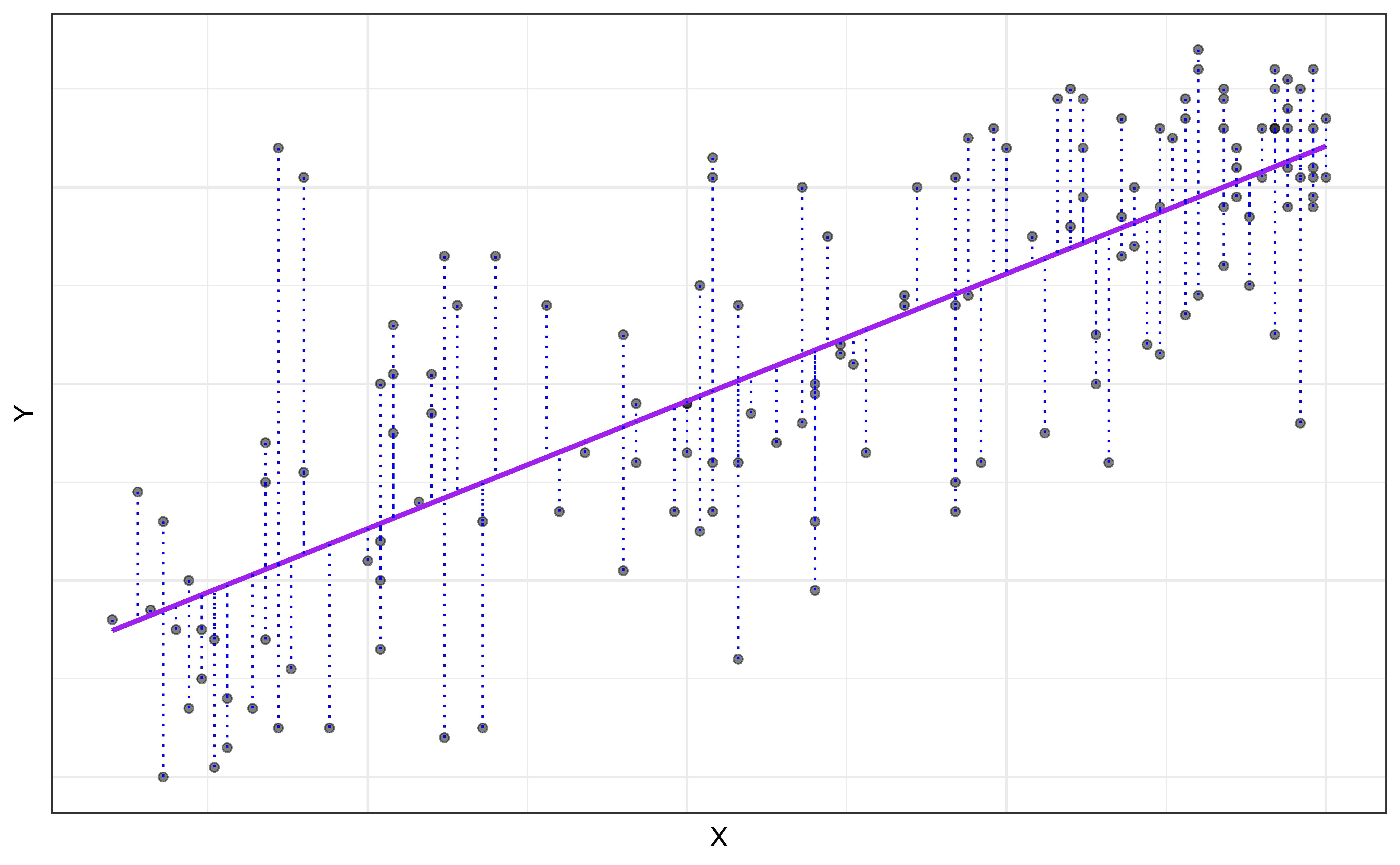
\[\begin{aligned} Y &= \color{black}{\textbf{Model}} + \text{Error} \\[8pt] &= \color{black}{\mathbf{f(X)}} + \epsilon \\[8pt] &= \color{black}{\boldsymbol{\mu_{Y|X}}} + \epsilon \end{aligned}\]

Regression model

\[\begin{aligned} Y &= \color{purple}{\textbf{Model}} + \text{Error} \\[8pt] &= \color{purple}{\mathbf{f(X)}} + \epsilon \\[8pt] &= \color{purple}{\boldsymbol{\mu_{Y|X}}} + \epsilon \end{aligned}\]
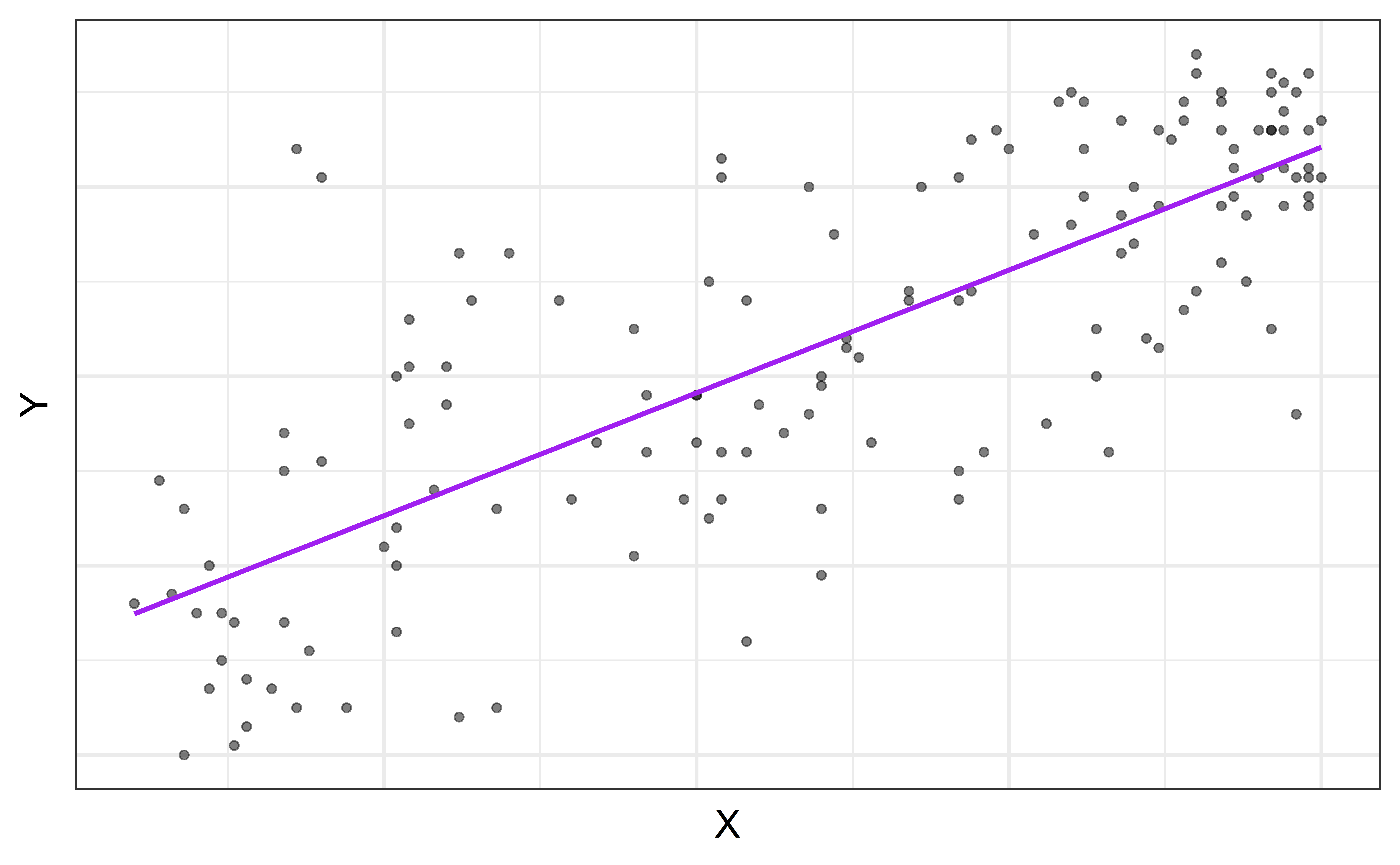
\(\mu_{Y|X}\) is the mean value of \(Y\) given a particular value of \(X\).

Regression model

\[ \begin{aligned} Y &= \color{purple}{\textbf{Model}} + \color{blue}{\textbf{Error}} \\[5pt] &= \color{purple}{\mathbf{f(X)}} + \color{blue}{\boldsymbol{\epsilon}} \\[5pt] &= \color{purple}{\boldsymbol{\mu_{Y|X}}} + \color{blue}{\boldsymbol{\epsilon}} \\[5pt] \end{aligned} \]
Simple linear regression (SLR)

SLR: Statistical model

  • Simple linear regression: model to describe the relationship between \(Y\) and \(X\) where:
    • \(Y\) is a quantitative/numerical reponse
    • \(X\) is a single quantitative predictor
    • \[\Large{Y = \mathbf{\beta_0 + \beta_1 X} + \epsilon}\]
  • \(\beta_1\): True slope of the relationship between \(X\) and \(Y\)
  • \(\beta_0\): True intercept of the relationship between \(X\) and \(Y\)
  • \(\epsilon\): Error

SLR: Regression equation

\[\Large{\hat{Y} = \hat{\beta}_0 + \hat{\beta}_1 X}\]

  • \(\hat{\beta}_1\): Estimated slope of the relationship between \(X\) and \(Y\)
  • \(\hat{\beta}_0\): Estimated intercept of the relationship between \(X\) and \(Y\)
  • \(\hat{Y}\): Predicted value of \(Y\) for a given \(X\)
  • No error term!

Choosing values for \(\hat{\beta}_1\) and \(\hat{\beta}_0\)
Residuals
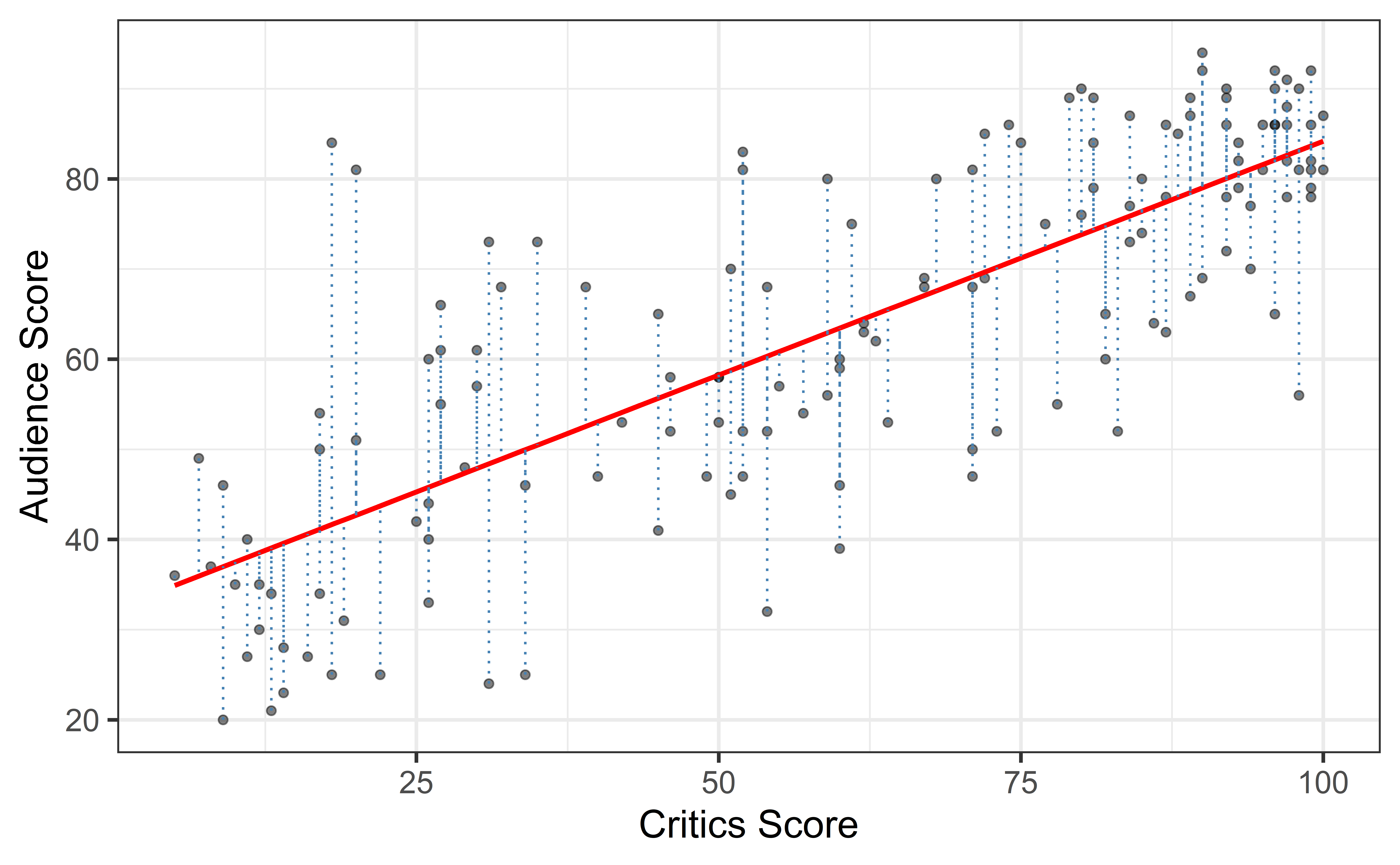
\[\text{residual} = \text{observed} - \text{predicted} = y_i - \hat{y}_i\]

Least squares line

  • Residual for the \(i^{th}\) observation:

\[e_i = \text{observed} - \text{predicted} = y_i - \hat{y}_i\]

  • Sum of squared residuals:

\[e^2_1 + e^2_2 + \dots + e^2_n\]

  • Least squares line is the one that minimizes the sum of squared residuals

Slope and intercept

Properties of least squares regression

  • Passes through center of mass point, the coordinates corresponding to average \(X\) and average \(Y\): \(\hat{\beta}_0 = \bar{Y} - \hat{\beta}_1\bar{X}\)

  • Slope has same sign as the correlation coefficient: \(\hat{\beta}_1 = r \frac{s_Y}{s_X}\)

    • \(r\): correlation coefficient
    • \(s_Y, s_X\): sample standard deviations of \(X\) and \(Y\)
  • Sum of the residuals is zero: \(\sum_{i = 1}^n e_i \approx 0\)

    • Intuition: Residuals are “balanced”
  • The residuals and \(X\) values are uncorrelated

Estimating the slope

\[\large{\hat{\beta}_1 = r \frac{s_Y}{s_X}}\]

\[\begin{aligned} s_X &= 30.1688 \\ s_Y &= 20.0244 \\ r &= 0.7814 \end{aligned}\]
\[\begin{aligned} \hat{\beta}_1 &= 0.7814 \times \frac{20.0244}{30.1688} \\ &= 0.5187\end{aligned}\]


Clickhere for details on deriving the equations for slope and intercept which is easy if you know multivariate calculus.

Estimating the intercept

\[\large{\hat{\beta}_0 = \bar{Y} - \hat{\beta}_1\bar{X}}\]

\[\begin{aligned} &\bar{x} = 60.8493 \\ &\bar{y} = 63.8767 \\ &\hat{\beta}_1 = 0.5187 \end{aligned}\]
\[\begin{aligned}\hat{\beta}_0 &= 63.8767 - 0.5187 \times 60.8493 \\ &= 32.3142 \end{aligned}\]


Click here for details on deriving the equations for slope and intercept.

Interpretation

  • Slope: For each additional unit of \(X\) we expect the \(Y\) to increase by \(\hat{\beta}_1\), on average.
  • Intercept: If \(X\) were 0, we predict \(Y\) to be \(\hat{\beta}_0\)

For our example, we have \(\hat{\beta}_1 = 0.5187\), and \(\hat{\beta}_0 = 32.3142\). How would you interpret these values in context?

02:00

Does it make sense to interpret the intercept?

The intercept is meaningful in the context of the data if

  • the predictor can feasibly take values equal to or near zero, or

  • there are values near zero in the observed data.

🛑 Otherwise, the intercept may not be meaningful!

Our first AE!

Group Work Roles

Any time we are working on AEs, I will randomly assign you to groups of two/three. Each person will have a role:

  • Driver: Writes code and fills out Quarto template. Responsible for submitting final work.
  • Reporter: Share thoughts from group during class discussions
  • Gopher: Responsible for looking stuff up (e.g. code, cheatsheets, etc.)

You’ll stay in your groups for three exercise and then we’ll switch (you must rotate your role every class.)

Driver \(\to\) Reporter \(\to\) Gopher \(\to\) Driver

Application exercise

Wrap up

Recap

  • Used simple linear regression to describe the relationship between a quantitative predictor and quantitative response variable.

  • Used the least squares method to estimate the slope and intercept.

  • Interpreted the slope and intercept.

    • Slope: For every one unit increase in \(x\), we expect y to change by \(\hat{\beta}_1\) units, on average.
    • Intercept: If \(x\) is 0, then we expect \(y\) to be \(\hat{\beta}_0\) units