Logistic regression
Introduction
Nov 01, 2024
Announcements
- Project: Paper Due November 18th
- Oral R Quiz
📋 AE 18 - Intro to Logistic Regression
- Open up AE 18
Logistic regression
Topics
Introduction to modeling categorical data
Logistic regression for binary response variable
Relationship between odds and probabilities
Computational setup
Predicting categorical outcomes
Types of outcome variables
Quantitative outcome variable:
- Sales price of a house
- Model: Expected sales price given the number of bedrooms, lot size, etc.
Categorical outcome variable:
- Indicator of being high risk of getting coronary heart disease in the next 10 years
- Model: Probability an adult is high risk of heart disease in the next 10 years given their age, total cholesterol, etc.
Models for categorical outcomes
Logistic regression
2 Outcomes
- 1: “Success” (models probability of this category…)
- 0: “Failure”
Multinomial logistic regression
3+ Outcomes
- 1: Democrat
- 2: Republican
- 3: Independent
2024 election forecasts
2020 NBA finals predictions

Data: Framingham Study
This data set is from an ongoing cardiovascular study on residents of the town of Framingham, Massachusetts. We want to use the total cholesterol to predict if a randomly selected adult is high risk for heart disease in the next 10 years.
Variables
- Response:
high_risk:- 1: High risk of having heart disease in next 10 years
- 0: Not high risk of having heart disease in next 10 years
- Predictor:
totChol: total cholesterol (mg/dL)
Complete Exercises 1-2.
Plot the data
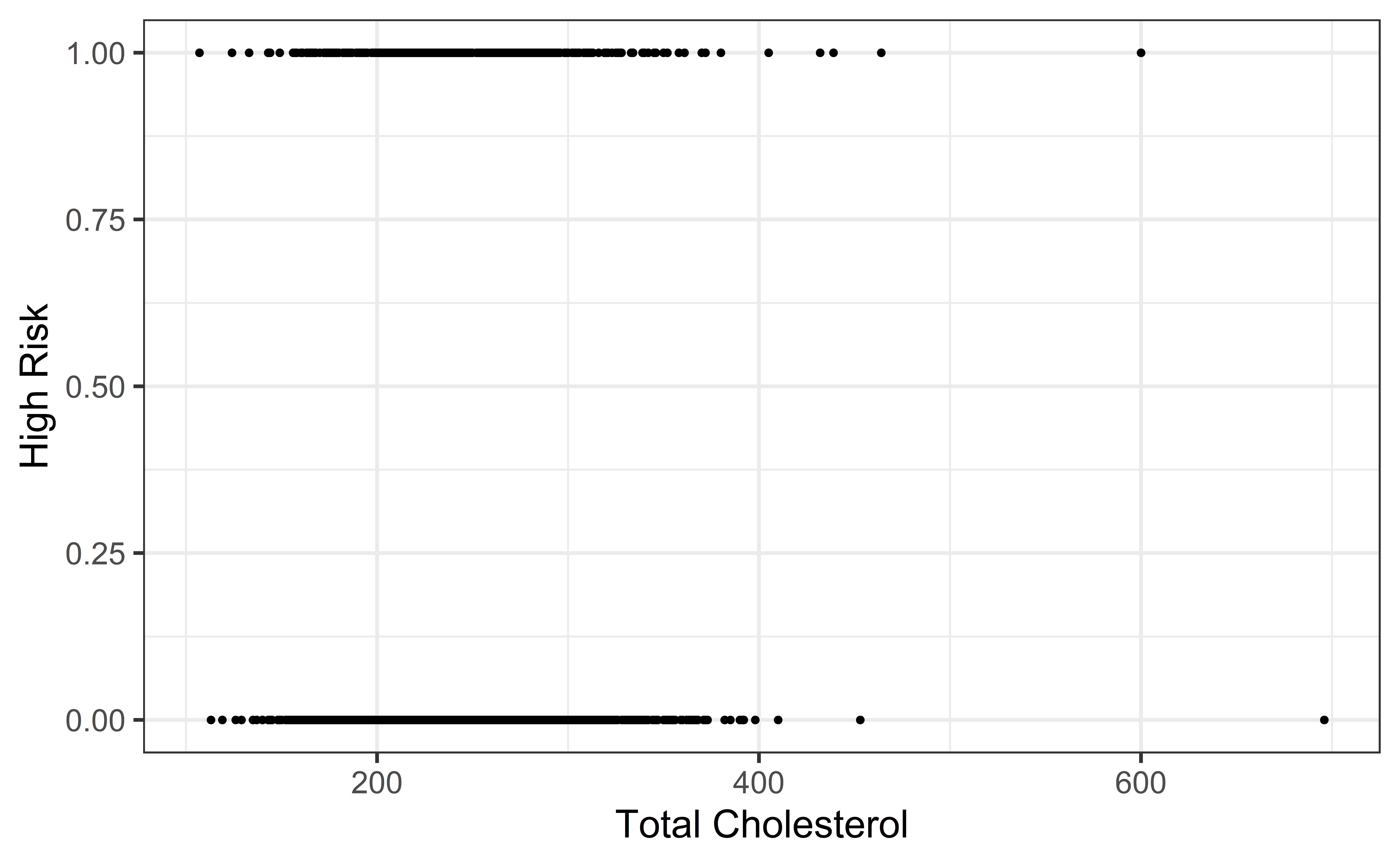
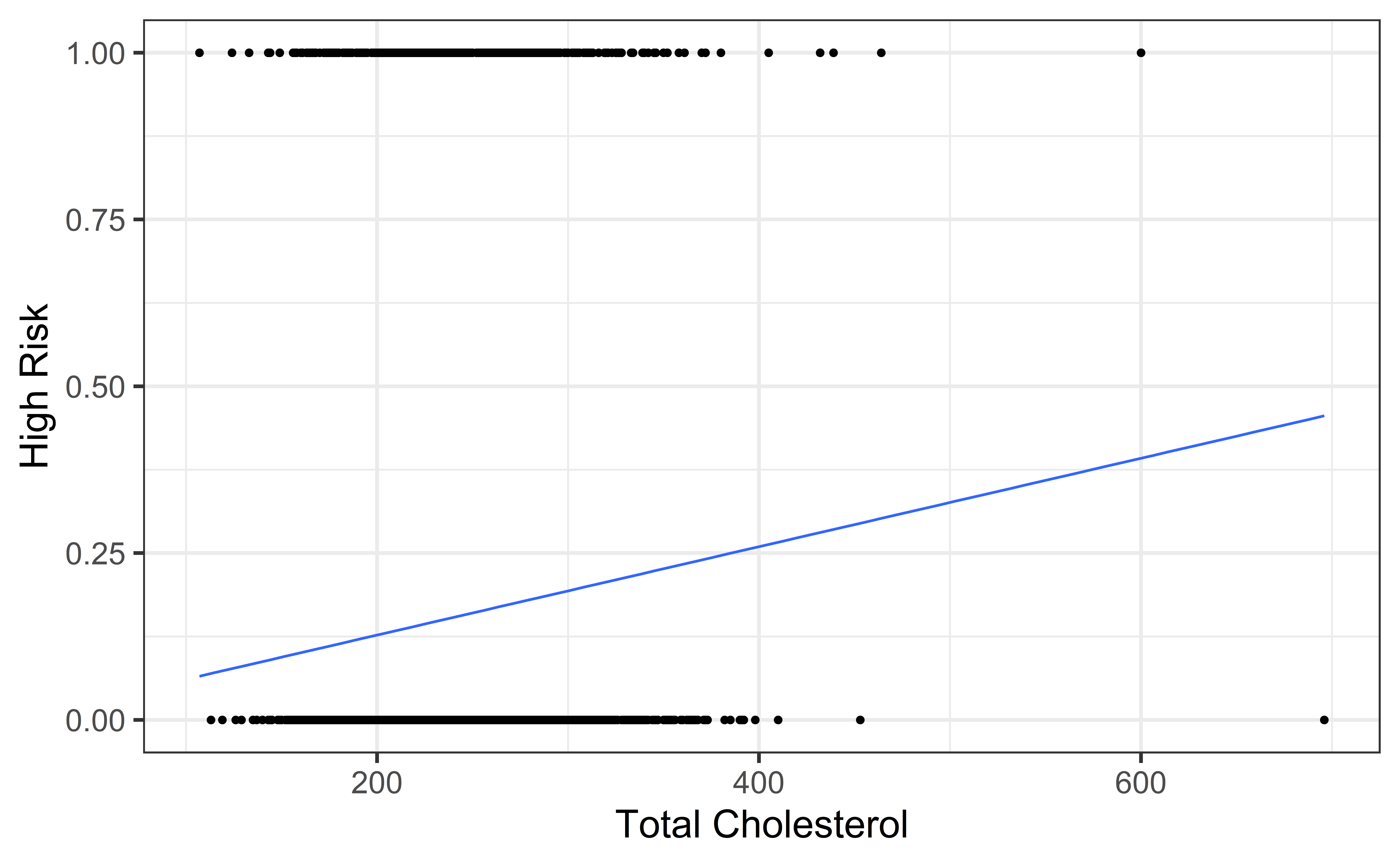
Let’s fit a linear regression model
Outcome: \(Y\) = 1: high risk, 0: not high risk
What happens if we zoom out?
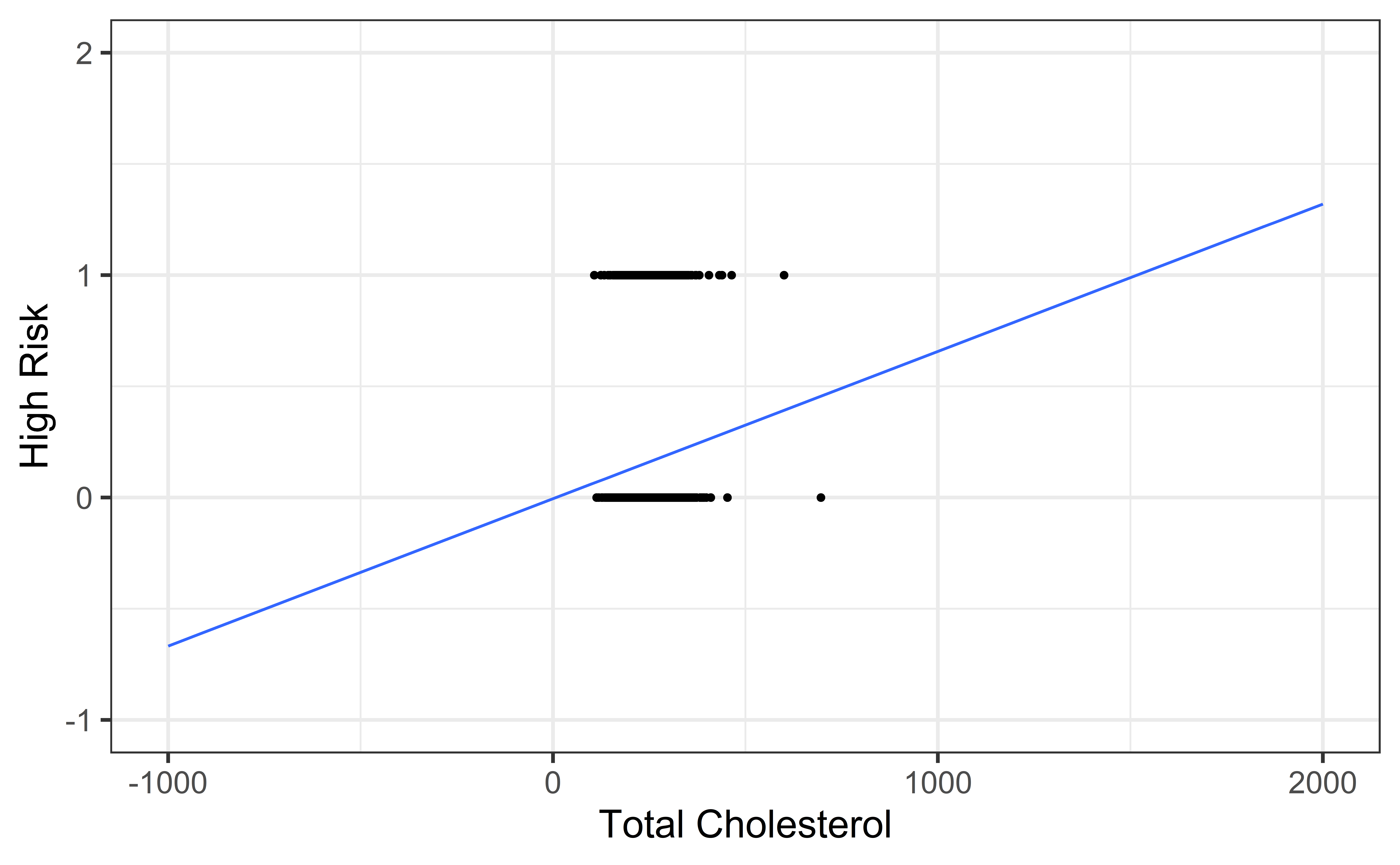
🛑 This model produces predictions outside of 0 and 1.
Let’s try another model
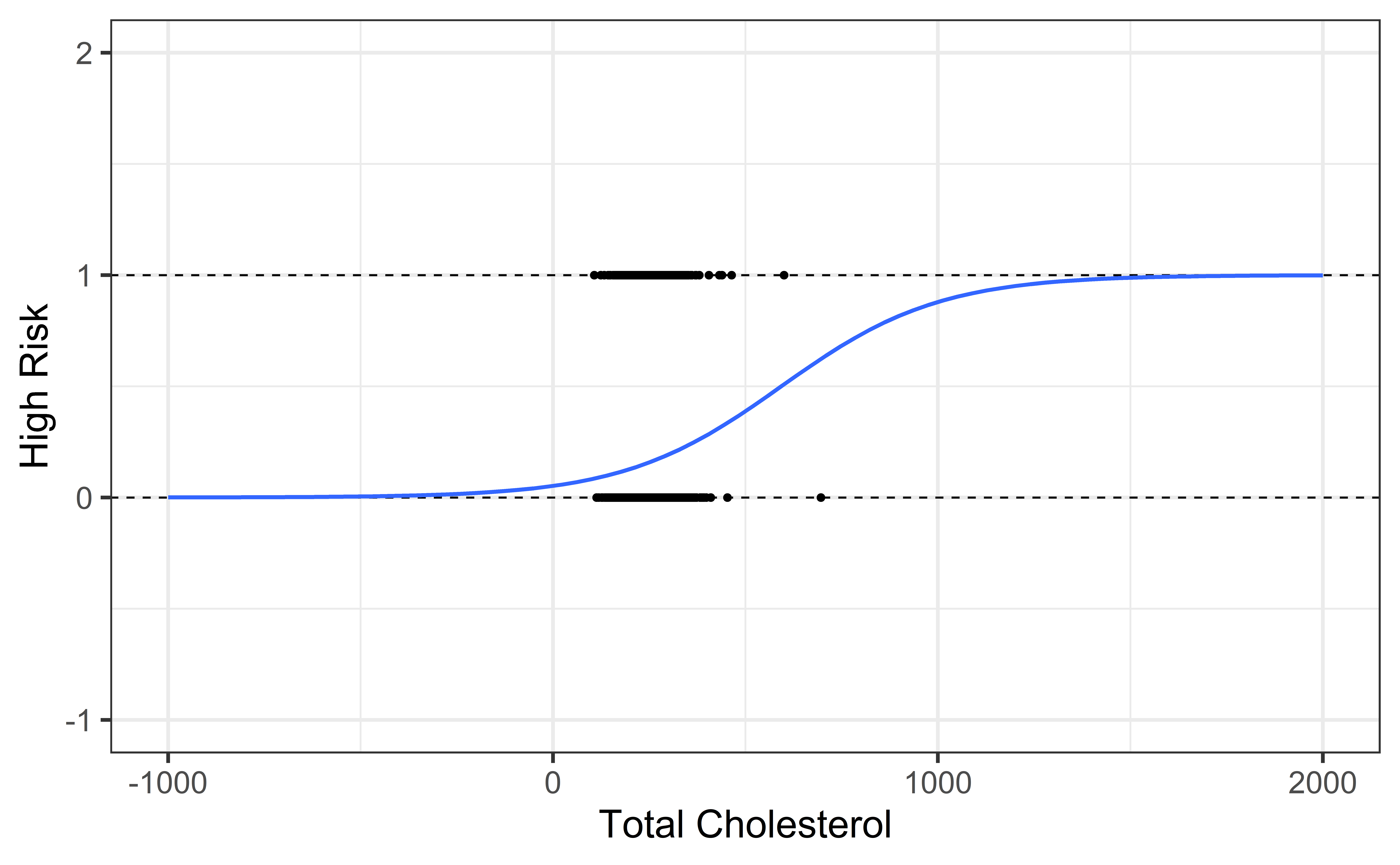
✅ This model (called a logistic regression model) only produces predictions between 0 and 1.
The code
Different types of models
| Method | Outcome | Model |
|---|---|---|
| Linear regression | Quantitative | \(Y = \beta_0 + \beta_1~ X\) |
| Linear regression (transform Y) | Quantitative | \(\log(Y) = \beta_0 + \beta_1~ X\) |
| Logistic regression | Binary | \(\log\big(\frac{\pi}{1-\pi}\big) = \beta_0 + \beta_1 ~ X\) |
Note: In this class (and in most college level math classes) ((and and in R)) \(\log\) means log base \(e\) (i.e. natural log)
Linear vs. logistic regression
Complete Exercise 3.
Linear vs. logistic regression
State whether a linear regression model or logistic regression model is more appropriate for each scenario.
Use age and education to predict if a randomly selected person will vote in the next election.
Use budget and run time (in minutes) to predict a movie’s total revenue.
Use age and sex to calculate the probability a randomly selected adult will visit St. Lukes in the next year.
Odds and probabilities
Binary response variable
- \(Y\):
- 1: “success” (not necessarily a good thing)
- 0: “failure”
- \(\pi\): probability that \(Y=1\), i.e., \(P(Y = 1)\)
- \(\frac{\pi}{1-\pi}\): odds that \(Y = 1\)
- \(\log\big(\frac{\pi}{1-\pi}\big)\): log-odds
- Go from \(\pi\) to \(\log\big(\frac{\pi}{1-\pi}\big)\) using the logit transformation
Odds
Suppose there is a 70% chance it will rain tomorrow
- Probability it will rain is \(\mathbf{p = 0.7}\)
- Probability it won’t rain is \(\mathbf{1 - p = 0.3}\)
- Odds it will rain are 7 to 3, 7:3, \(\mathbf{\frac{0.7}{0.3} \approx 2.33}\)
- Log-Odds it will rain is \(\log\mathbf{\frac{0.7}{0.3} \approx \log(2.33) \approx 0.847}\)
What are the odds of developing heart disease?
Complete Exercise 4.
From log-odds to probabilities
log-odds
\[\omega = \log \frac{\pi}{1-\pi}\]
odds
\[e^\omega = \frac{\pi}{1-\pi}\]
probability
\[\pi = \frac{e^\omega}{1 + e^\omega}\]
Logistic regression
From odds to probabilities
- Logistic model: log-odds = \(\log\big(\frac{\pi}{1-\pi}\big) = \beta_0 + \beta_1~X\)
- Odds = \(\exp\big\{\log\big(\frac{\pi}{1-\pi}\big)\big\} = \frac{\pi}{1-\pi}\)
- Combining (1) and (2) with what we saw earlier
\[\text{probability} = \pi = \frac{\exp\{\beta_0 + \beta_1~X\}}{1 + \exp\{\beta_0 + \beta_1~X\}}\]
Logistic regression model
Logit form: \[\log\big(\frac{\pi}{1-\pi}\big) = \beta_0 + \beta_1~X\]
Probability form:
\[ \pi = \frac{\exp\{\beta_0 + \beta_1~X\}}{1 + \exp\{\beta_0 + \beta_1~X\}} \]
Recap
Introduced logistic regression for binary response variable
Described relationship between odds and probabilities