Logistic regression continued

Introduction

Prof. Eric Friedlander

Nov 06, 2024

Announcements

πŸ“‹ AE 19 - Intro to Logistic Regression Continued

  • Open up AE 19 and complete Exercise 0.

Logistic regression

Topics

  • Use R to fit logistic regression models
  • Interpret coefficients of logistic regression models
  • Use logistic regression model to calculate predicted odds and probabilities

Computational setup

# load packages
library(tidyverse)
library(ggformula)
library(ggforce)
library(broom)
library(knitr)

# set default theme and larger font size for ggplot2
ggplot2::theme_set(ggplot2::theme_bw(base_size = 20))

Data: Framingham Study

This data set is from an ongoing cardiovascular study on residents of the town of Framingham, Massachusetts. We want to use the total cholesterol to predict if a randomly selected adult is high risk for heart disease in the next 10 years.

heart_disease <- read_csv("data/framingham.csv") |>
  select(totChol, TenYearCHD, age, BMI, cigsPerDay, heartRate) |>
  drop_na()

Variables

  • Response:
    • TenYearCHD:
      • 1: Patient developed heart disease within 10 years of exam
      • 0: Patient did not develop heart disease within 10 years of exam
  • Predictors:
    • totChol: total cholesterol (mg/dL)
    • age: age in years

Logistic regression

Logistic regression model

Logit form: \[\log\big(\frac{\pi}{1-\pi}\big) = \beta_0 + \beta_1~X\]

Probability form:

\[ \pi = \frac{\exp\{\beta_0 + \beta_1~X\}}{1 + \exp\{\beta_0 + \beta_1~X\}} \]

Today: Using R to fit this model.

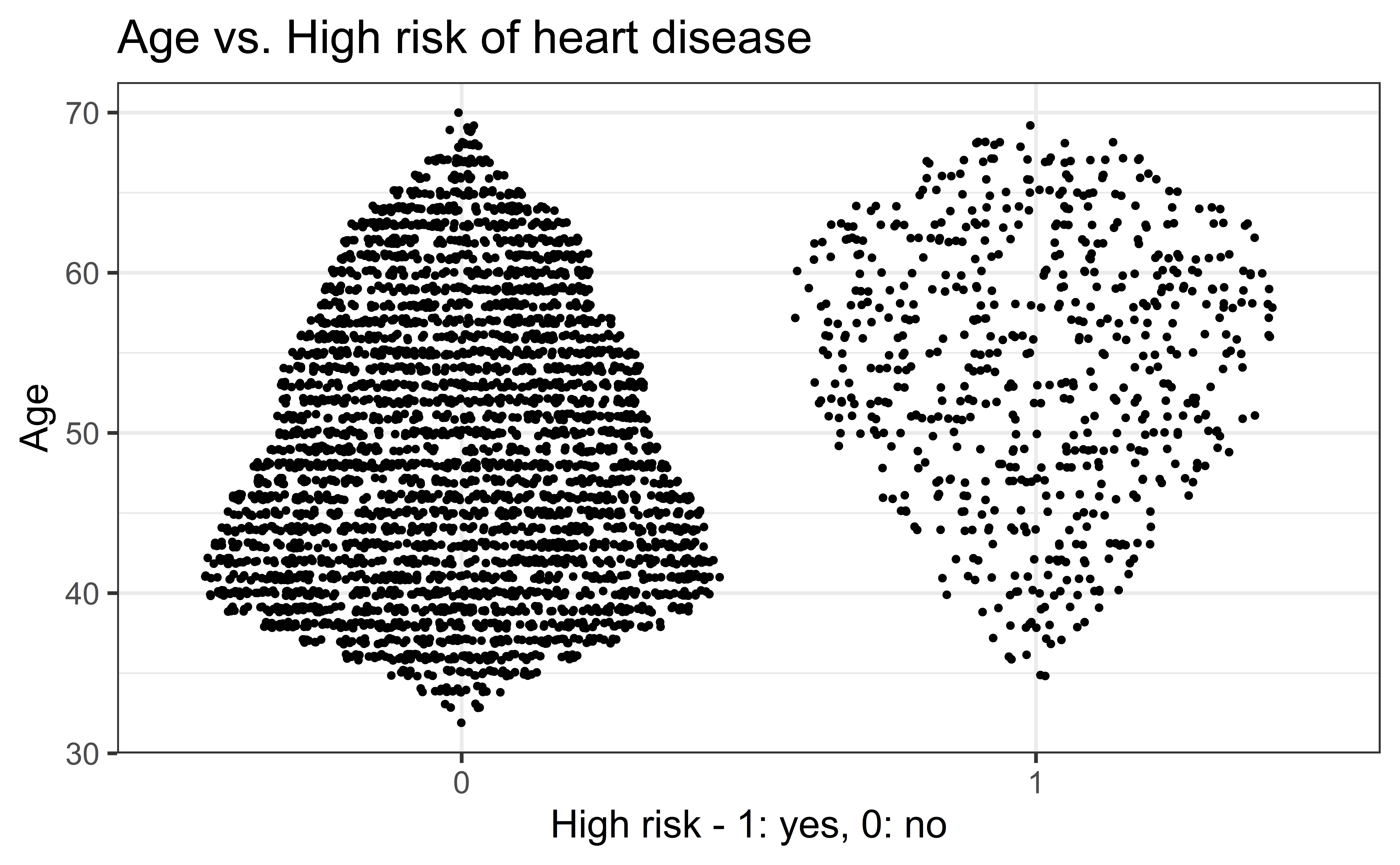
High risk vs. age

heart_disease |> 
gf_sina(age ~ factor(TenYearCHD)) |> 
  gf_labs(x = "High risk - 1: yes, 0: no",
       y = "Age", 
       title = "Age vs. High risk of heart disease")

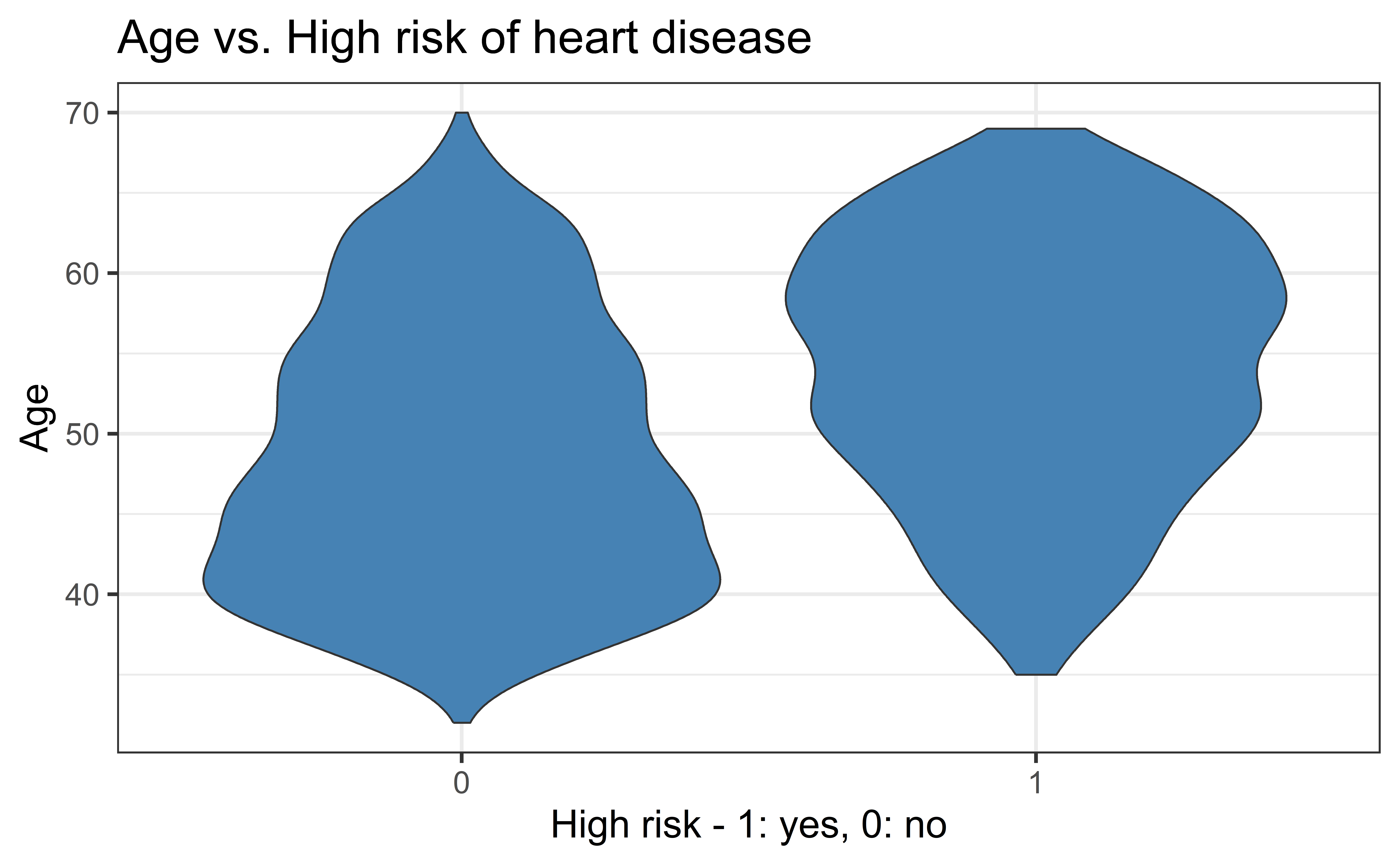
High risk vs. age

heart_disease |> 
gf_violin(age ~ factor(TenYearCHD), fill = "steelblue") |> 
  gf_labs(x = "High risk - 1: yes, 0: no",
       y = "Age", 
       title = "Age vs. High risk of heart disease")

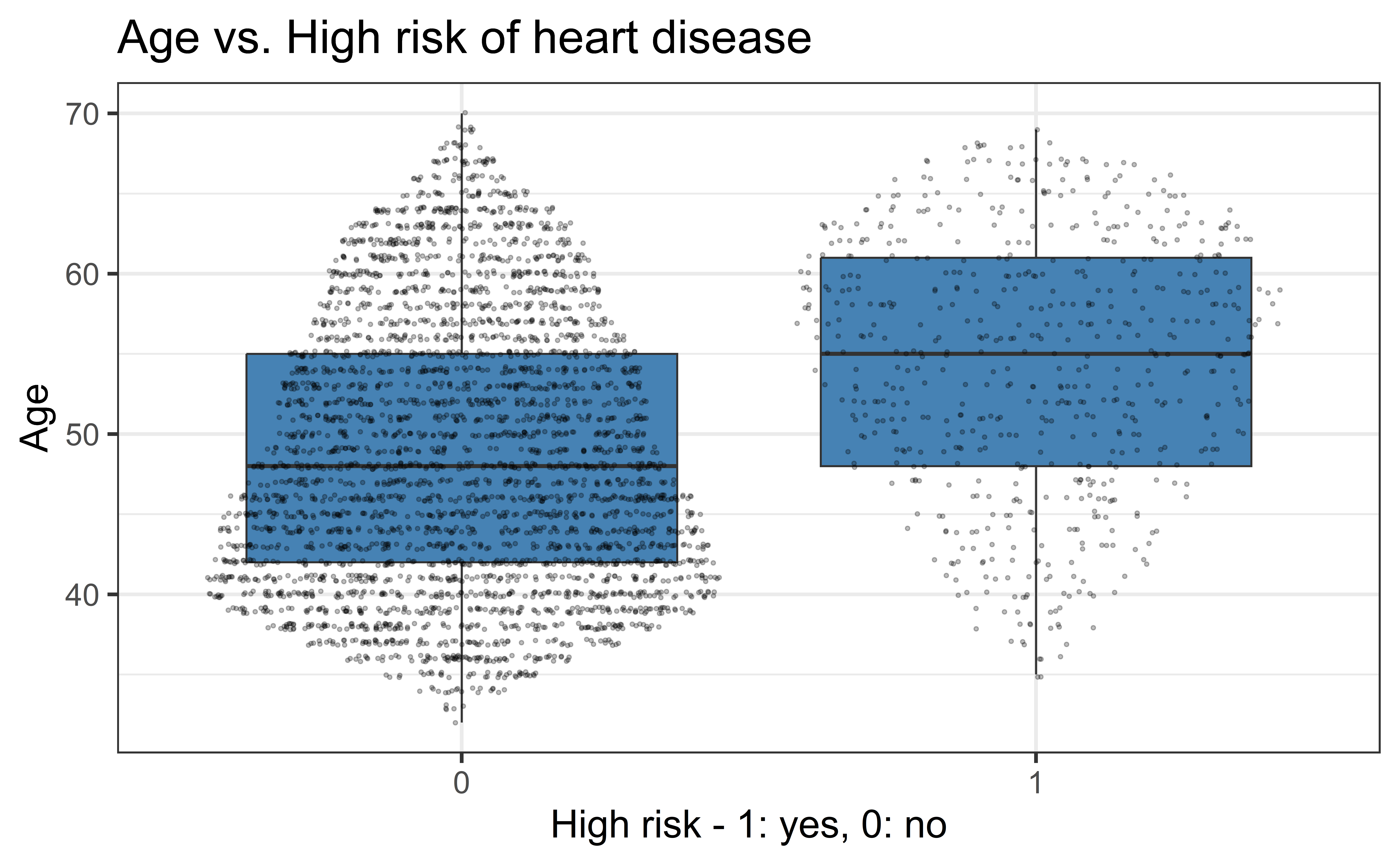
High risk vs. age

heart_disease |> 
gf_boxplot(age ~ factor(TenYearCHD), fill = "steelblue") |> 
  gf_sina(size = 0.75, alpha=0.25) |> 
  gf_labs(x = "High risk - 1: yes, 0: no",
       y = "Age", 
       title = "Age vs. High risk of heart disease")

Let’s fit a model

heart_disease_fit <- glm(TenYearCHD ~ age, data = heart_disease, family = "binomial")

tidy(heart_disease_fit) |> kable(digits = 3)
term estimate std.error statistic p.value
(Intercept) -5.661 0.290 -19.526 0
age 0.076 0.005 14.198 0

The model

tidy(heart_disease_fit) |> kable(digits = 3)
term estimate std.error statistic p.value
(Intercept) -5.661 0.290 -19.526 0
age 0.076 0.005 14.198 0

\[\textbf{Logit form:}\qquad\log\Big(\frac{\hat{\pi}}{1-\hat{\pi}}\Big) = -5.561 + 0.075 \times \text{age}\]

\[\textbf{Probability form:}\qquad\hat{\pi} = \frac{\exp(-5.561 + 0.075 \times \text{age})}{1+\exp(-5.561 + 0.075 \times \text{age})}\]

where \(\hat{\pi}\) is the predicted probability of developing heart disease in the next 10 years.

Interpreting \(\hat{\beta}\)’s

tidy(heart_disease_fit) |> kable(digits = 3)
term estimate std.error statistic p.value
(Intercept) -5.661 0.290 -19.526 0
age 0.076 0.005 14.198 0

For every addition year of age, the log-odds of developing heart disease in the next 10 years, increases by 0.077.

Complete Exercises 1 - 3.

Interpretability of \(\beta\) for predicted probabilities
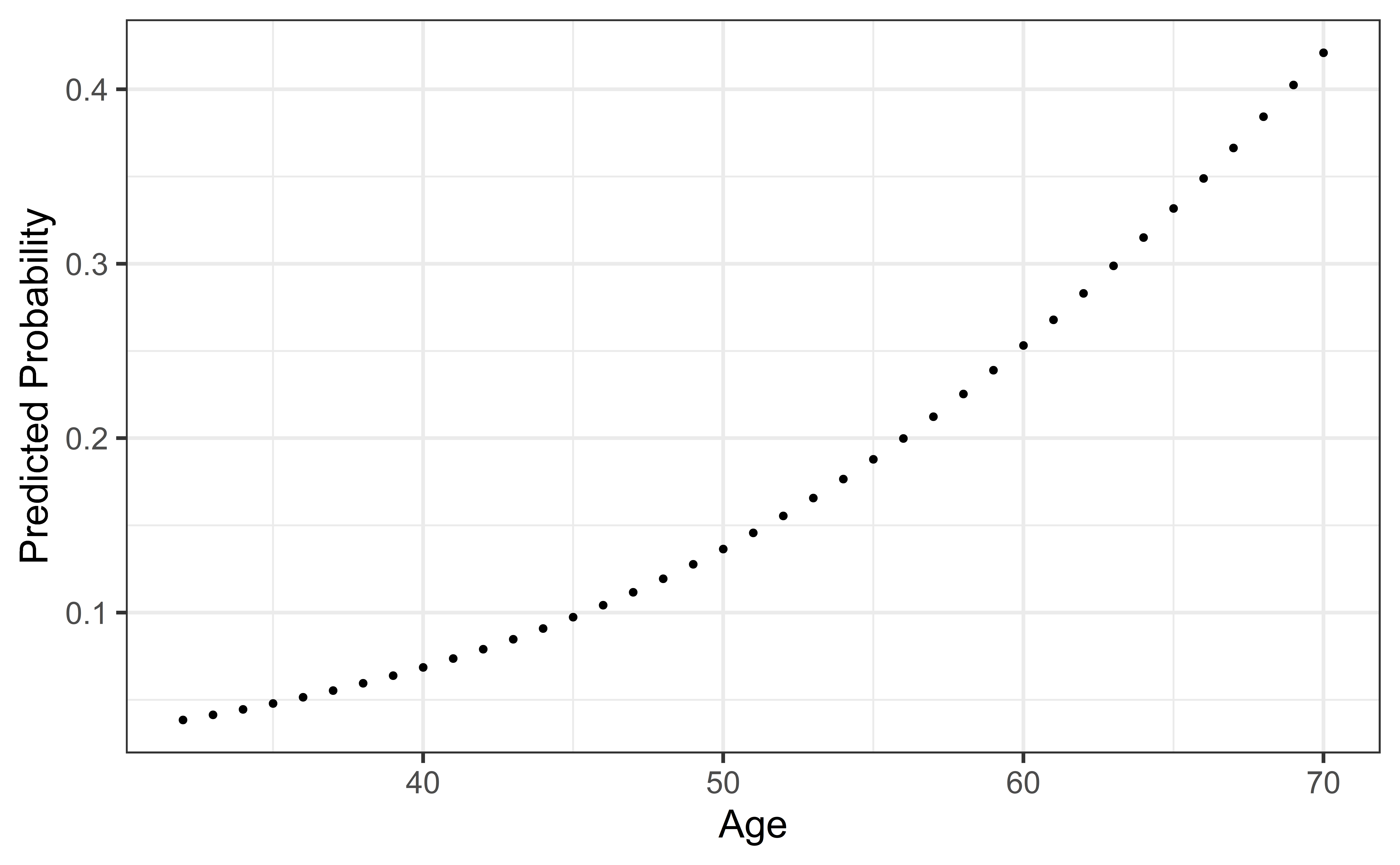
  • SLOPE IS CHANGING!
  • Increase in \(\hat{\pi}\) due to increase of 1 year of Age depends on what starting age is

glm and augment

The .fitted values in augment correspond to predictions from the logistic form of the model (i.e. the log-odds):

augment(heart_disease_fit)  |> head()
# A tibble: 6 Γ— 8
  TenYearCHD   age .fitted .resid     .hat .sigma   .cooksd .std.resid
       <dbl> <dbl>   <dbl>  <dbl>    <dbl>  <dbl>     <dbl>      <dbl>
1          0    39   -2.68 -0.363 0.000472  0.891 0.0000161     -0.363
2          0    46   -2.15 -0.469 0.000330  0.891 0.0000192     -0.469
3          0    48   -2.00 -0.504 0.000295  0.891 0.0000200     -0.504
4          1    61   -1.01  1.62  0.000730  0.891 0.000999       1.62 
5          0    46   -2.15 -0.469 0.000330  0.891 0.0000192     -0.469
6          0    43   -2.38 -0.421 0.000393  0.891 0.0000182     -0.421

Note: The residuals do not make sense here!

For observation 1

\[\text{predicted probability} = \hat{\pi} = \frac{\exp\{-2.650\}}{1 + \exp\{-2.650\}} = 0.066\]

Using predict with glm

Default output is log-odds:

predict(heart_disease_fit, new_data = heart_disease) |> head() |> kable(digits = 3)
x
-2.685
-2.150
-1.998
-1.006
-2.150
-2.379

Using predict with glm

More commonly you want the predicted probability:

predict(heart_disease_fit, newdata = heart_disease, type = "response") |> head() |> kable(digits = 3)
x
0.064
0.104
0.119
0.268
0.104
0.085

Complete Exercise 4

Recap

  • Fit logistic regression models using glm
  • Interpreted coefficients in logistic regression models
  • Used logistic regression model to calculate predicted odds and probabilities
  • Use predict to make predictions using glm